Here. Take the glass.
Both hands. It's heavier than it looks. Brass, old, my grandfather's, and his grandfather's before. The one thing I love about it is that it doesn't connect to a single thing on this earth. No Wi-Fi, no Bluetooth. Everything down in that valley is connected to a server in a state I will never visit. This, this is connected to my eye, and as of right now, to yours, which makes the two of us the only honest instruments in the valley. Put it up. That eye. Now look down, and don't make a face, because I'm going to need you not to flinch tonight, and we may as well find out now whether you've got the stomach for the view. We'll start off slow. Ease you in.
The valley lights up at five PM as the sun ducks below the hill behind us. It does it on a schedule. The whole grid blinks awake in a wave that rolls house by house, west to east, like a fart spread across a room by a cheap box fan. There. You've got it now. You're doing the only honest day's work done around here, and you don't even know it yet. You're grading them.
Start at the east end. The Donnellys go first and go big. Four figures of gaudy light, and tomorrow a man from the paper will come up to photograph it like a centerfold. Look at it. Really look. Nobody to perform for up here, just you and me and a glass that doesn't lie. Now tell me that isn't a turd. A turd painted red and gold and lit from the inside, and they paid four figures to make it that, and they'll do it again next year. You see it. That's the trouble with the glass. I hand a person one honest look and ruin every Christmas card they'll ever receive.
Swing it. Two doors down, the gingerbread men, big as porch columns, brown and grinning like idiots, posted on either side of a third one. Go on. You grade this one. I want to see if it took. The two on the ends came out crisp. The one they propped between them came out wrong, went soft somewhere in the cold and started to list, sagging brown and boneless against its own stake. A shit sandwich, and I mean it to the letter: two good slices standing guard over the soft brown middle, the buttons looking like undigested nuts. And somewhere a designer charged them for the composition and slept fine. Good. You're a natural. I had my doubts about you for a second there, I'll be honest, I thought you might be one of them.
Now find the tree. Center of the square, forty feet of imported fir, the one they put on the gate sign and the brochures, and here's where a lesser man keeps reaching into the toilet for this joke. I won't. I want you to see the tree clean, because the tree isn't shit. The tree is worse than shit. The tree is the town. Every color the catalog sold, strung by people who have never once in their lives made an artistic expression, who were handed a list, bought the list, and called it taste. I've watched that tree get worse through this same glass for ten years. Its final form: rainbow diarrhea.
"You just said you wouldn't reach for the toilet on this one. And what is your obsession with poop?"
That's Max. From the doorway. Lower the glass for a second. Max gets ignored at a man's peril.
"It isn't an obsession," I said. "It's a vocabulary. A man works with what the subject gives him, and the subject is fecal matter."
"And who," Max said, "are you talking to?"
There it is. See, the dog misses nothing. I didn't answer that one, and I'd thank you not to make it an issue either, because the honest reply is that I've got company up here for the first time in a long while, and I'm not ready to look at what that says about me. Put the glass back up. We were having a nice time.
To prove I contain range, I found the Baloguns. A fourteen-foot inflatable Santa that dies every morning the instant the fan cuts out, slumps face-first into the boxwood, and every evening a grown man comes out to stand it back up. "There," I said. "That isn't a decoration. It's an analogy for erectile dysfunction."
Max thought it over. "Better," Max said, and gave the whole valley a two, which is what Max gives everything, and put that cinderblock head back down on matching paws and pushed a long breath out through the snout, which is how a dog laughs, and which I have learned not to take personally.
I should square you up on Max before you get ideas, because you've heard the dog talk twice now and you're being polite about it. Max is a dog. A big one. Junkyard stock, ninety pounds of opinion I found abandoned at the bottom of the hill, a brown eye and a blue one, the one that judges and the one that forgives. Max does not, technically, speak. I'm aware of this. I am aware that the night a man starts taking decorating notes from a dog he hauled out of a ditch is a night certain people would jot down. You can jot it down too, if you like. You're up here. You're holding the glass. You don't get to jot down much.
You'll want to know whose lights you've been grading, so look at the whole thing at once. Westhaven is the city, but what matters is the Westhaven Homeowner Organization, or WHO to its friends, which is everyone, because down there friendliness is not a temperament, it's a bylaw. There's a sign at the gate, four feet tall. It says GLAD TIDINGS, and underneath, smaller, the hours. They have hours for the tidings. That's the part that finishes me, and I've handed it to you now, so it can finish you too.
You think this is all about taste. That I'm up here because the lights are ugly. The lights are ugly, and that's the joke, and the joke is the part I let you keep. Here's the part I don't hand to just anybody, so hold still for it. A man doesn't climb a cold hill his whole life over ugly. I don't hate the way they do Christmas. I hate Christmas. The day itself. It comes up the calendar at me every year on the same square, dragging all of this up the hill behind it, the bells and the memories. There has never been one thing I could do to make it not come. You can hate a man and trust him to die someday. This day won't die. It came back every year I've been alive and it will come back the year they carry me off this hill, exactly this cheerful, right on time. And it isn't contempt, whatever I make it sound like up here. Contempt is the easy part, the loud part, the part with the jokes in it. What's under it is quiet and it is old and it does not have a single joke in it, and you felt the floor of it go just now. I watched you feel it. I've handed you more than I meant to. Look at the hill instead.
And up here, the hill. Swing the glass back to your own feet. The good lot. The best lot, the crown jewel of the whole valley, the one on every brochure, the view every realtor down there points at and then has to change the subject about. Squatting on top of it like a wart on a wedding cake: my trailer. Forty feet of single-wide the color of a dead tooth, parked where the house used to stand. Renches have been up here since before there was a valley to look down into. My great-great-great-grandfather stood on this exact dirt and threw light across the whole territory with a pair of mirrors, a signal man flashing warning signs when danger approached a country that had no valley in it yet, because somebody in this family has always been the one up high with something to his eye, watching. That glass in your hands came down the same line he did. My grandfather built the house with his own two hands, his father grazed goats, five generations born and married and laid out on this ground. And now there's me, and a trailer, and a dog, sitting on the most expensive ground in the county, with WHO grown up around the hill on three sides like water around a rock it can't be bothered to move. The kids at the bottom have their own name for this ground. The crumb pit. A house high on a hill, burned to black crumbs, and a child names what he sees from the bottom and never asks what it was. Five generations, and what the WHO's children call the place is leftover trash you sweep off a soiled mouth.
Here's the thing they can't do anything about. I want you to hold onto that, because it's the joke the whole valley would pay to stop me telling: I'm not one of them. Never signed a page. WHO has an association made of every HOA in town (charter, color-approved palette, a man named Dale who measures the height of your grass against a laminated card), but they built it around the hill and forgot to make the hill sign, so they can't fine me, can't cite me, can't send Dale up the path with his little card, because there is nothing up here they are allowed to measure. What they can do, under the guise of neighborly goodwill, is invite me. They come under the door in cream envelopes, hand-addressed to MR. G. RENCH in calligraphy that cost real money, every one landing on my floor like a pile of belly up roaches. I read them out loud to Max, doing the voices, and then I feed them to the stove, and the two of us watch them burn.
And the punchline (lean in, this one's mine and they never get to hear it) is that I keep them warm. Every gingerbread house down there runs its heat off a unit I touched with these two hands and crawl back to service on my knees when it quits, which it does, in January, always, at the worst hour, and then it's me they call. The wart on the cake. I've got a key, a code, or a standing service call into damn near every house in that valley, because I'm the only man in it who knows what's humming under their floors. They will not have me to dinner. They will not say my name in daylight. But every soul down there has had me in their basement, and not one of them can get through a winter without me. They hate me, and they cannot get warm without me, and I've decided that's a fair trade. For now.
I said for now, and the hill, right on cue, sent up a visitor. Keep the glass on the path. I want you to watch this with me, because I'm not going to be able to describe it to you fairly and I'd rather you saw it yourself.
You hear him before you see him. The wrong shoes on the ice, that quick scuffling negotiation a man makes with a slope he's too proud to respect, and then Stuart Aldrich comes up out of the dark into my porch light, breathing hard, in a camel coat that cost more than my truck, holding a single folded sheet of paper out in front of him like a man coming to preach the good news.
Aldrich is Meridian. The signature at the bottom of everything this valley is. He built the suburban hellscape you've been grading, and he has wanted this last dozen acres back since before I was old enough to keep it from him. Here's what you should understand before you go taking his side, because you're going to want to. He did not send someone up the hill. He came himself, on foot, on the ice, in the dark, at his age, which a fairer man than me might have called a courtesy "Grant," he said, like we were friends. "God, that path. You ought to put in a rail." He got his wind and looked past me, at the trailer, at the weight set rusting in the yard where a lawn would be if I were a different man, four hundred pounds of iron I've thrown around in the dark for seventeen years because a gym charges a membership and therapy was never an option. Then he looked at me. Six foot four of me. Two hundred and fifty pounds, filling the doorframe I stood in. Something behind his eyes ran the math on the distance back to his car.
There's a school of thought, preached to me by better men than I turned out to be, that with a certain kind of visitor you say nothing at all and let the silence do the work. I have never once managed it. I don't have the discipline and I've stopped pretending I want it. He'd climbed my hill in the dark to enjoy himself, and there was no taking that away from him, so I did the only thing left on the board, which was to make certain I enjoyed it more. Watch. This is the part you came up here for, whether or not you'd ever say it out loud.
"You should have called ahead," I said. "I'd have told you to piss off and saved you the trouble of coming up here to bother me."
He smiled like I'd handed him something. He'd budgeted for worse and gotten it cheap.
"It's the county's, not mine," he said of the paper, and held it a little higher. "Thought you'd rather hear it from a person than a process server you don't know. Neighborly at the least."
"Neighborly," I said. "You climbed a mountain in the cold to bring a man the worst paper of his year by hand, so you could stand in his light and watch his face take it. That's a longer word than neighborly, Stuart, and we both know which one. Epicaricacy. I'd ask you inside to look it up, but you can see for yourself there's nowhere in there a man like you could sit."
I didn't step out of the door when I said it. He'd never step foot inside. That's the joke, and he heard it, and the smile drew a half-inch tighter across his teeth.
I took the paper out of the air, because leaving it hanging between us was lending it a weight it hadn't earned, and because a man holding a thing out that long starts to look like he's begging you to relieve him of it. I didn't read it. I didn't have to. I've been doing the numbers on the backs of work orders for a year. A man who fixes furnaces can't pay the tax on a view he never wanted, so on the first of the year the county does its sums and auctions the ground out from under me, a forced sale, pennies on the dollar, to whoever shows up first with a check. And the man who'd show up first, the man already first in line, was standing on my porch catching his breath and calling it a favor.
"It doesn't have to come to that," he said. "You don't have to let it go to auction at all. Sell it to me now, straight across, before the county ever gets its hands on it, and you walk away with real money in your pocket instead of watching strangers bid on your family's land for a tenth of what it's worth. We had it appraised twice this fall. It's worth more than you've let yourself think. A good deal more. Seven figures, Grant."
I'd spent all year keeping the number small in my head, small enough to live with, and he'd just told me how much I'd been pretending it wasn't. Don't pretend you don't know what this hill is worth. It's the whole reason I made you watch.
"There it is," I said. "You carried that number up the ice the whole way and saved it so you could see my face. Seven figures. You practiced it in the car." I folded the county's paper along the crease it came up with and slid it into the chest pocket of my coveralls. "But it was never the money, and that's the part that's going to keep you up tonight. You've run this valley so long you think everything standing in it comes with a price, a man's dignity included, and you are going to drive back down that hill honestly unable to work out why I didn't take your money. That isn't a flaw in the offer. It's the whole of what I've got against you, what you've done to this place. You built a thing that runs on signatures. You put yours under more of them than most men breathing and never once had to learn whose name sat above it. I'm the name that isn't on the page. That's why this hill keeps you up nights and always has: it's the one square of your county you never got a signature for, and it's going to stay that way so long as I have breath."
His eyes went up the slope behind me for a second, the old wanting in them he never could hide. "Hell of a view, Grant. Always was wasted up here."
"Wasted," I said, and stood up straight, unfolded my arms.
"You know what I mean."
"I do," I said, and it was the only honest thing either of us managed, because we both knew exactly what he meant and we both knew I'd heard it clean, a hatred old enough it could almost pass for understanding.
He went back down the hill. The wrong shoes again, slower, both hands out for his balance. Watch him go with me. Watch him the whole way down through the brass glass, and hope the ice takes him and piles him up at the bottom in a broken heap. The man had come up here on foot in the dark and offered me a fortune and a clean way out, said it to my face like a gentleman, and I stood in my own door and wished him dead for it. I'm not going to dress that up for you. I want you to know where this night is headed.
You'd have done the same. Rejected his blood money. Don't tell me you wouldn't. You graded a man's gingerbread a minute ago and laughed.
They are not getting the hill.
When I came back in, Max was sitting where Max sits, and had already arrived at a verdict.
"You enjoyed that," Max said.
"I walked a man back down a hill under his own power who came up it to bury me. I was a perfect gentleman."
"You were a lot of things." Max let that stand. "It's the sixth."
"I'm aware what day it is."
"You've been at this a long time." Max watched me with the brown eye and the blue one. "You don't have to go down there tonight."
"I do, though."
Max didn't argue. Never argues the point when I'm right. Just got up.
There's one thing in this trailer I am not going to hand you. I've handed you everything else: the glass, the valley, the joke, the number, a man's slow walk down the ice. But not this. This stays mine.
I'll tell you it's on the fridge, where I pass it forty times a day. I'll tell you it's a photograph. Or it was. The edges are gone to char, curled and black, burned from all four corners in toward the middle, in toward the one part that's still a picture, like the whole thing came out of a fire somebody reached into and didn't reach far enough. I'll tell you the one part that's still a picture is a girl. Seven, maybe. Mid-laugh, head tipped, a gap where a front tooth ought to be that she's grinning about like she earned it, like it was a thing she'd done on purpose and pulled off clean. That's what's left of her. The rest is ash. I'll tell you that much, because you held my family's spy glass and you graded my neighbors and you wished a man ill, and you've earned that much.
I look at it every morning. Every line of it is burned into me. I could draw it with my eyes shut, the tooth, the tip of the head, the hand half up, and I look anyway, and for about four seconds the whole act comes off the hook at once, the grading, the hate, and there's just a man in a cold trailer holding the corner of a burned photograph of a child. And then the four seconds are up, because they have to be. Putting it back under the magnet costs more than taking it down ever does.
I'm not going to tell you who she is. I don't care how long you stood up here with me. We've only just met.
So I got dressed.
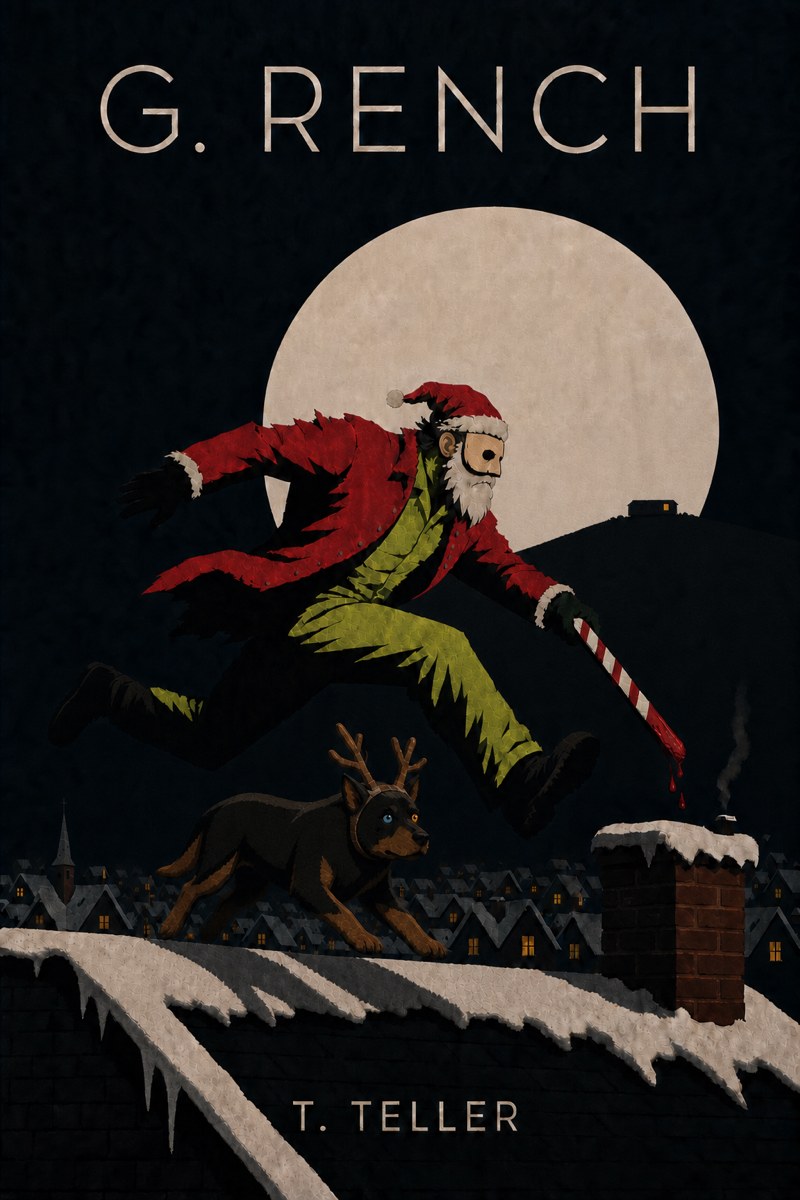
Green coveralls first. They go on like a second skin now. Or maybe the skin is the costume and the coveralls are the man. I lose track. Then, over them, the Santa suit. It's a cheap one. Synthetic, a size too small, pulls across the back, rides up at the wrists, the beard fixed to a half-mask that drops the whole face on at once like a lid. Which suits me fine. I've never been much to look at. The hat goes on last and I look in the mirror. It's a terrible costume. It's meant to be a terrible costume. Anyone who sees me tonight will go to the police and report a big, jolly Santa with a reindeer for a dog, and they'll be walked gently back to their car, because the truth, said out loud, is too unbelievable to be frightening. That's the one thing this town ever taught me worth keeping, and now you've got it too. Be careful what you do with it.
I buckled the antlers onto Max. Brown leather, hand-stitched, sized to a cinderblock head. Then, because the antlers alone never quite sell it, I uncapped the Sharpie and drew the eyebrows on, two high, surprised little arcs above the brown eye and the blue, the face of a creature delighted by everything that has ever happened.
The last thing I do is the name. I wrote it on the back of my left hand in the same Sharpie, where I'd see it all night and where no one else would think to look. Block letters, two words: VIVIAN PHELPS. Then I cover it with my work gloves. You saw that. I let you see it. There's a Winter Wonderland down in the valley tonight, a Christmas program, the grid lit and waiting and warm, warm because I made it warm. Vivian runs the lights for the show. When it starts she'll be off by herself. Alone. Afraid.
You didn't say anything when I wrote it, either. I noticed. Max noticed. Just like the man who walked the number to my door in the cold, you should also wish her dead.
"Stay behind me on the path," I told Max. "It's icy where the lights don't reach."
"It's always icy where the lights don't reach," Max said.
Smartest thing anyone's said on this hill in seventeen years.
So put the glass down now. Gently. It's older than both of us. You won't need it where we're going. Down there you look at the lights close, close enough that you can see what makes them shine, and with the twist of a wrist, make them stop shining. I clipped the lead, and I opened the door, and you came too. You've been walking the whole time. You just didn't feel your feet move.
One Santa, one reindeer, and you. Down the hill, to steal their Christmas.